Tuesday, August 13, 2013


Comparing Normal EEG (Top) 
and 

EEG with generalized seizure (Down) 


Monday, August 12, 2013


Q: Why patients with Citalopram (Celexa) overdose should be observed in hospital or ICU for longer period of time than other SSRIs ?


Answer:  

Patients with citalopram (and escitalopram) overdose should be observed in telemetry bed for at least 13 hours or preferably 24 hours, because of the risk of delayed toxicity, resulting in prolonged QTc interval and consequent cardiac dysrhythmias like torsades de pointes). Another life threatening side effect is occurrence of seizure. 

Patients with other SSRIs overdose are usually OK to discharge after observation for 8-10 hours.

In general, dose for Celexa above 40 mg/day are not recommended because of the risk for QT prolongation.


Reference: 

1. Pacher P, Ungvari Z, Nanasi P, et al. Speculations on difference between tricyclic and selective serotonin reuptake inhibitor antidepressants on their cardiac effects. Is there any? Current Medicinal Chemistry 1999; 6:469-480. 

2. Grundemar L, Wohlfart B, Lagersteedt C, et al. Symptoms and signs of severe citalopram overdose. Lancet 1997; 349: 1602. 

3. Catalano G, Catalano MC, Epstein MA, et al. QTc interval prolongation associated with citalopram overdose: a case report and literature review. Clin Neuropharmacol 2001; May-June: 2-6.

Sunday, August 11, 2013

Q: After few minutes of getting first dose of Metronidazole, patient developed tachycardia, fever, shivering, sweating, dilated pupils, twitching, hyper-reflexia, hyperthermia. Patient became confused, agitated and hypertensive. Your concern?


Answer: Serotonin Syndrome from metronidazole

Symptoms of Serotonin syndrom has been reported with metronidazole. Treatment is discontinuation of drug and supportive treatment.


Reference:

Karamanakos, P. N. (2008). "The possibility of serotonin syndrome brought about by the use of metronidazole". Minerva Anestesiologica 74(11): 679.

Saturday, August 10, 2013

Q: Why Indomethacin is not advocated any more for the treatment of Dressler's Syndrome?


Answer: 

Indomethacin inhibits new collagen deposition, and thus impairs  the healing process for the infarcted myocardial region. NSAIDs in general are now less advocated in patients with ischemic heart disease. 

Preferred treatment  for Dressler's syndrome is now Colchicine. 

Corticosteroids are still popular with many folks particularly after cardiac surgeries, but the frequency of relapse is high when corticosteroid therapy is discontinued.

Wednesday, August 7, 2013

Q: What is the difference between between Paroxysmal, Persistent and Permanent Atrial fibrillation?


Answer: 
  TypeTime period differentiation
  Paroxysmal   recurrent episodes that self-terminate in less than 7 days.
  Persistent  recurrent episodes that last more than 7 days
Permanent  an ongoing long-term episode

Tuesday, August 6, 2013


 Q: How much is usually the loading dose of Amiodarone?


Answer: About 10 grams

An oral loading dose of Amiodarone is around a total of 10 grams, divided over 10 to 14 days. 

Afterwards, a typical maintenance dose of amiodarone is 100 or 200 mg daily.

Monday, August 5, 2013

Interesting article: "Blood-fluid levels in the brain"

"17 cases reviewed prospectively over a period of 4 months highlight then varied appearance of blood–fluid levels in intracranial cystic lesions of different aetiologies; a finding which has not featured significantly in the medical literature. Four types of intracranial cysts demonstrating blood–fluid levels have been categorised according to the nature of the pathology, i.e. primary neoplasms of the brain, metastatic deposits to the brain in cases of extraneural malignancies, lesions of vascular aetiology and intraparenchymal bleeds secondary to trauma......"


Reference: 

Blood-fluid levels in the brain - BJRvol. 80no. 954 488-498  

Sunday, August 4, 2013


Q: 38 year old female is admitted via ED for unilateral acute nephrolithiasis. Patient is admitted to ICU because of spiking fever, severe dehydration and azotemia. Renal ultrasound was performed in ED. Radiologist calls you to report "a fluid-fluid level" in renal pelvis. What does it mean? 
Answer:  Pyonephrosis 

"a fluid-fluid level" means urine on top of purulent debris. Ultrasound is a much better indicator in identifying pyonephrosis than CT imaging, which is usually performed without contrast in such situations due to severe dehydration and worsening azotemia. Needless to say, antibiotics are required.


Reference:

Jeffrey RB, Laing FC, Wing VW, Hoddick W. Sensitivity of sonography in pyonephrosis: a reevaluation.AJR Am J Roentgenol. Jan 1985;144(1):71-3.

Saturday, August 3, 2013


Q: Ethylene glycol intoxication causes Hypocalcemia or Hypercalcemia? (Choose one)
Answer:  Hypocalcemia

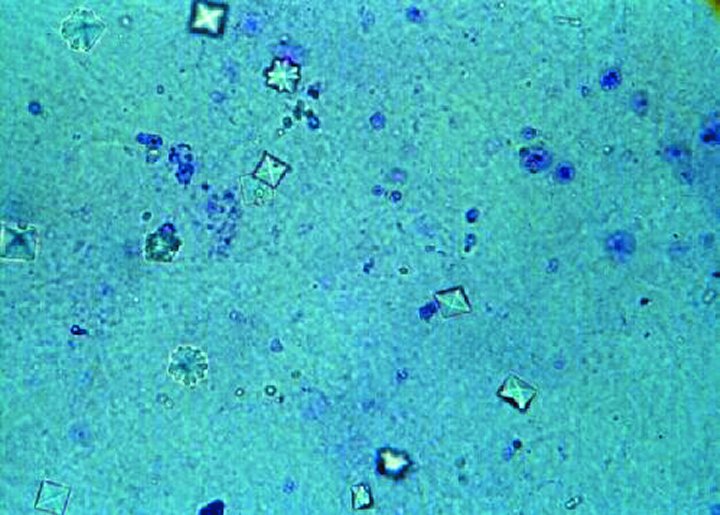
Ethylene glycol toxicity (anti freeze) causes hypocalcemia and usually starts occurring around 12 to 36 hours after ingestion. Ethylene glycol metabolized to oxalate and binds to calcium to form Calcium Oxalate crystals.

One of the clue almost always given in Critical Care Board exams is presence of envelope shaped Calcium Oxalate crystals in urine, though presence of it signifies pretty advance stage of toxicity.


File:Calcium oxalate crystals in urine.jpg

Friday, August 2, 2013

Q: What is the the last resort treatment in severe refractory ethanol intoxication?


Answer:  Hemodialysis

Hemodialysis very effectively get rid of ethanol from the blood but it is reserved for severe cases where neurological or hemodynamic situation may become life threatening.

In most cases of ethanol toxicity, supportive treatment is enough to ride off the intoxication phase with IV fluid, IV thiamine, preventing hypoglycemia, preventing electrolyte imbalance, transient use of vasopressors and maintaining normothermia.

Thursday, August 1, 2013

Q: What is the ratio of lipase to amylase in Acute alcoholic pancreatitis?


Answer:

In acute alcoholic pancreatitis, the lipase level is usually about 2.5 to 3 times that of amylase. It is a good indication of alcohol as a cause of pancreatitis proved otherwise.

Wednesday, July 31, 2013

 Q: How PEEP may contribute to induce pulmonary edema?


Answer:

PEEP may increase pulmonary edema by 2 factors

1, increasing intrathoracic pressure and
2, decreasing outflow of lymph


Tuesday, July 30, 2013

Q: Is it necessary to use heparinized saline in pressure bag for arterial line monitoring?


Answer: No

Previously, it was a standard to use heparinized saline to use with pressure bag during arterial line monitoring. But recent guidelines suggest NOT to use heaprinized saline. Simple saline is equally good for flushing blood and medications through arterial lines, and it poses minimal risk of causing adverse drug events like potential HIT (Heparin Induced Thrombocytopenia).


References:

1. Eliminate the Use of Heparin Solution with Arterial Lines - ihi.org recommendations, last update 04/23/2011

2. Whitta RK, Hall KF, Bennetts TM, Welman L, - Comparison of normal or heparinised saline flushing on function of arterial lines., Crit Care Resusc. 2006 Sep;8(3):205-8.

Sunday, July 28, 2013

Q: What bacteria E.coli has to do with Filgrastim (Neupogen)?


Answer:
Filgrastim  (Neupogen) is a granulocyte colony-stimulating factor (G-CSF) analog used to stimulate the proliferation and differentiation of granulocytes. It is produced by recombinant DNA technology.

The gene for human granulocyte colony-stimulating factor is inserted into the genetic material of Escherichia coli. The G-CSF then produced by E. coli is different from G-CSF naturally made in humans.

Saturday, July 27, 2013

Q; What are the 3 catheter based interventions to perform mechanical thrombectomy in massive/submassive pulmonary embolism?


Answer: 

Broadly there are 3 categories of percutaneous catheter intervention in pulmonary emboli:
  1. Aspiration thrombectomy,
  2. Thrombus fragmentation,
  3. Rheolytic thrombectomy*
Mechanical thrombectomy should be avoided beyond the main and lobar pulmonary arterial branches. Direct intra-arterial delivery of thrombolytics, may be helpful if mechanical thrombectomy is ineffective.


*Rheolytic thrombectomy catheters use a high-velocity saline jet to fragment adjacent thrombus by creating a Venturi effect.


References:

Fava M, Loyola S. Applications of percutaneous mechanical thrombectomy in pulmonary embolism. Tech Vasc Interv Radiol. 2003; 6: 53–58.

Cho KJ, Dasika NL. Catheter technique for pulmonary embolectomy or thrombofragmentation. Semin Vasc Surg. 2000; 13: 221–235.


Kucher N, Windecker S, Banz Y, Schmitz-Rode T, Mettler D, Meier B, Hess OM. Percutaneous catheter thrombectomy device for acute pulmonary embolism: in vitro and in vivo testing. Radiology. 2005; 236: 852–858

Friday, July 26, 2013

Q; What is the significance of increased Troponin in Pulmonary Embolism?


Answer: 

In acute pulmonary embolism, troponins probably rise because of acute right heart overload. The release is of shorter duration than in unstable angina, and the peak level is linked to the outcome.


References:
1. Müller-Bardorff M, Weidtmann B, Giannitsis E, et al. Release kinetics of cardiac troponin T in survivors of confirmed severe pulmonary embolism. Clin Chem. 2002; 48: 673–675.


2. Giannitsis E, Müller-Bardorff M, Kurowski V, et al. Independent prognostic value of cardiac troponin T in patients with confirmed pulmonary embolism. Circulation. 2000; 102: 211–217

Thursday, July 25, 2013

Q; Which test would be better in predicting septic arthritis?


Answer:  CRP


An elevated CRP (C-reactive protein) is helpful in determining the presence of a septic joint. The ESR and CRP are almost always raised on admission, CRP being more specific in diagnostics. Both elevated erythrocyte sedimentation rate (ESR) or C-reactive protein (CRP) is useful in following response to therapy.


Reference: Usefulness of CRP and ESR in predicting septic joints South Med J. 2010 Jun;103(6):522-6.  

Wednesday, July 24, 2013

Q; Tumor lysis syndrome may cause all except? (Choose one)


Answer:  C

Tumor lysis syndrome cause Hypocalcemia. Because of the hyperphosphatemia, calcium is precipitated to form calcium phosphate, leading to hypocalcemia. Hypocalcemia may lead to tetany, seizures etc.

Patients about to receive chemotherapy for a cancer with a high cell turnover rate, like lymphomas and leukemias, should receive prophylactic allopurinol as well as IV hydration to target urine output > 2.5 L/day. Rasburicase is an alternative to allopurinol. Alkalization of the urine is controversial and has shown no difference.

Tuesday, July 23, 2013

Q; Which tumors are more prone to give negative cytology in malignant pleural effusion?
Answer:
Generally cytology is positive only in approximately 60 percent of malignant pleural effusions, but following tumors are more prone to have negative cytology.
  • mesothelioma,
  • sarcoma, and
  • lymphoma
Other factors which effects the cytology of malignant effusion are the tumor burden in the pleural space, amount of pleural fluid submitted and the expertise of the cytologist.
Usually 10 mL of pleural fluid should be adequate for cytologic processing.


References:
1. Maskell NA, Butland RJ, Pleural Diseases Group, Standards of Care Committee, British Thoracic Society. BTS guidelines for the investigation of a unilateral pleural effusion in adults. Thorax. 2003;58(suppl 2):ii8–17.
2. Sallach SM, Sallach JA, Vasquez E, Schultz L, Kvale P. Volume of pleural fluid required for diagnosis of pleural malignancy. Chest. 2002;122:1913–7.

Monday, July 22, 2013

Septic Pulmonary Emboli


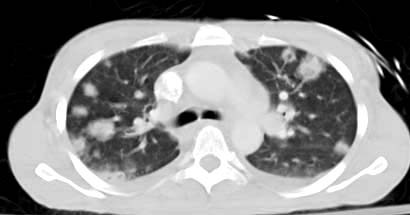
Septic emboli, pulmonary CT
Often seen in IV drug users or immunocompromised patients with right sided bacterial endocarditis. Unhygienic IV drug use may inadvertently inject skin flora into the bloodstream which then seeds the tricuspid valve, shooting off emboli into the lungs. Physical exam may reveal a holosystolic murmur that increases in intensity with inspiration. Note the bilateral peripheral parenchymal nodules on lung CT.
  
Septic pulmonary emboli is embolization of intravascular thrombus containing microorganisms into the lungs. Septic emboli can occur from varying sources like tricuspid valve endocarditis, infection elsewhere in the body with associated septal defect, infected deep venous thrombosis, venous lines / central venous catheters, pacemaker wires etc.

On CT chest, "vessel sign" is interesting to watch with peripheral nodules with clearly identifiable feeding vessels. May be visible are - subpleural nodular lesions or wedge-shaped densities with or without necrosis caused by septic infarcts.

Sunday, July 21, 2013

CPAP vs Bi-PAP ventilation
(Basics)

Source: http://youtu.be/BdeOiDJmbrk

Friday, July 19, 2013

Q: Which lung cancer is more prone to produce Syndrome of Inappropriate Antidiuretic Hormone (SIADH)?

Answer: Small cell lung cancer

SIADH is associated with a number of malignancies but most notably with small-cell lung cancer.

SIADH can also occur following head injury, following neck dissection and manipulation of the nervous system, few drugs like morphine, NSAIDs etc and in a number of  other pulmonary processes like pneumonia, abscess, and tuberculosis. It can also occur with endocrine diseases like hypothyroidism and glucocorticoid deficiency.


Thursday, July 18, 2013

Q: What is clinical importance of Mayo-Robson point?


Answer:

A point just above and to the right of the umbilicus is called Mayo-Robson's point. At this point the tail of pancreas is projected on the abdominal wall. Here tenderness on pressure exists in diseases of the pancreas and it is a one clinical sign in acute pancreatitis.

Wednesday, July 17, 2013


 LEMON for Airway intubation


Some providers use the LEMON pneumonic to help them assess an airway

L- Look externally (facial trauma, teeth, facial hair, etc.)

E- Evaluate thyromental distance

M- Mallampati Class

O- Obstruction (airway edema, tracheal mass, mediastinal mass, etc.)

N- Neck mobility

Tuesday, July 16, 2013

Q: What is large bore IV?


Answer: At least 16 gauge  and ideally 12-14 gauge.
As contrary to popular belief and practice central line is not a large bore or resuscitation line.
Rapid infusion of volume is based on basic physics of Hagen-Poiseuille equation. As per Hagen-Poiseuille equation just 2 fold increase in radius increase flow by 16 fold but 2 fold increase in length decrease flow by 50%.
Technically regularly available central lines (TLC or PICC line) is not ideal for IVF bolus due to longer length and smaller radius. 2 Large bore (say 16 gauge) peripheral IVs or one large bore central short IV (cordis) are real placements for aggressive resuscitation (due to bigger radius and shorter length).


Point is: Central line or two 18 G peripherals should not be labeled as large bore IVs.

Monday, July 15, 2013

Q: 17 year old male is admitted with bloody diarrhea and vomiting. Patient visited petting zoo 3 days ago with his friend. Now patient is hypotensive, no urine out put and altered mental status. Probable diagnosis?


Answer: HUS

Hemolytic Uremic syndrome (HUS) should be high on list with bloody diarrhea after visit to petting zoo. Other risk factors include contamination via hamburger or contact to infected person.

  • The GI symptoms usually starts after 4-6 days. Diarrhea typically become hemorrhagic and may quickly set into septic shock.

Antibiotics are usually not required, actually discouraged. Minor cases can be treated with supportive treatment but in cases like above plasma exchange (plasmapheresis combined with fresh-frozen plasma replacement) is currently the treatment of choice.

Sunday, July 14, 2013

Q: Ideally, mature Arterio-Venous Fistula (AVF) for hemodialysis should have which basic properties?
Answer:
Ideally, mature AVF should have the following characteristics to be safely punctured:
1. discernible vein margins,
2. flow greater than 600 mL/min,
3. vein diameter at least 0.6 cm and
4. should be located no more than 0.6 cm deep


Y. C. Kim, J. Y. Won, S. Y. Choi, H. K. Ko, K. H. Lee, Y. do Lee, B. C. Kang, S. J. Kim, 2009 Percutaneous treatment of central venous stenosis in hemodialysis patients: long-term outcomes. Cardiovasc Intervent Radiol 32 2 271 278

Saturday, July 13, 2013

Q: 54 year old male who is POD # 22 heart transplant is found to have symptomatic bradycardia with heart rate of 24. Resident administered 3 mg of Atropine without any effect. Your explanation?


Answer:  

Atropine is ineffective and should be avoided in heart transplant patients. The vagus nerve is not retransplanted after transplant and so Atropine would be useless in symptomatic bradycardia.

The transplanted heart is able to function in its new host through the capacity of its intact, intrinsic nervous system.The heart's nervous system contains around 40,000 neurons, called sensory neurites, which detect circulating hormones and neurochemicals and sense heart rate and pressure information. Hormonal, chemical, rate and pressure information is translated into neurological impulses by the heart's nervous system and sent from the heart to the medulla in brain through several afferent pathways. The signals have a regulatory role over many of the autonomic nervous system signals that flow out of the brain to the heart, blood vessels and other glands and organs.


Murphy D A, Thompson G W, et al (2000), The heart reinnervates after transplantation. Annals of Thoracic Surgery; 69(6): 1769-1781.

Thursday, July 11, 2013

Q: 36 year old female is in ICU with septic shock and diagnosed with strongyloidiasis. She also has severe GI ileus and was made NPO . She is on ivermectin. What is your option to administer her essential treatment? 


Answer: Rectal or SC administration of Ivermectin 

 Ivermectin is the drug of choice for strongyloidiasis. It is usually given as PO with empty stomach but if PO route is note feasible, it can be given rectally or even as SC administration. 


 Fusco DN, Downs JA, Satlin MJ, Pahuja M, Ramos L, Barie PS, et al. Non-oral treatment with ivermectin for disseminated strongyloidiasis. Am J Trop Med Hyg. Oct 2010;83(4):879-83

Wednesday, July 10, 2013

Q: What is "botulinum cook" ?

Answer:


Botulinum toxin is destroyed by proper thorough cooking but the spore itself is not killed by the temperatures at normal boiling. Spores may grow again when conditions are right. All commercially canned goods are required to undergo a "botulinum cook" in a pressure cooker at 121 °C (250 °F) for 3 minutes, which most likely will kill spores.

Clinically most important thing to remember besides history taking is - paralysis is usually in descending fashion, starting from cranial nerves downward towards arms and legs. It also may effect respiratory muscles. Initial symptoms are double vision, drooping of both eyelids, loss of facial expression, swallowing  and speech  problems. The weakness then spreads - starting in the shoulders and proceeding to the forearms - and again - from the thighs down to the feet.

Most updated review we found on Botulism is at Medscape website, Click here 

http://emedicine.medscape.com/article/213311-overview

Tuesday, July 9, 2013

Q: 28 year old male, who just returned from Bangladesh 2 days ago presented to ED with vomiting, painless but profuse "rice water" type diarrhea - almost 20 liter/day! which smells like fish. On examination patient skin seems turning a bluish-gray hue. Your concern?

 
Answer: Cholera
The hallmark of cholera is profuse, painless diarrhea and vomiting of clear fluid. Clinical symptoms starts from few hours upto five days after ingestion of the bacteria. The diarrhea is clasically described as "rice water" with fishy odor. Patient may produce 10 to 20 litres of diarrhea a day. Cholera has been nicknamed the "blue death" due to a patient's skin turning a bluish-gray hue from massive dehydration.

Doxycycline is the first line of agent for treatment, followed by cotrimoxazole, erythromycin, tetracycline, chloramphenicol,and furazolidone. Fluoroquinolones, such as norfloxacin, also may be used.

Monday, July 8, 2013

Adenosine and limbs numbness


 Adenosine can make patients' limbs feel numb for about 2–5 minutes after intravenous administration particularly when total administration is above 12 mg.