Q: What length of dialysis catheter is appropriate for insertion via femoral vein?
Answer: 20-24 cm
Insertion of hemodialysis catheters less than 15-17 cm may cause higher recirculation rates as tip of the catheter is probably positioned in the iliac vein. Similarly, contrary to popular belief very long catheter like more than 30-32 cm is not appropriate either as flow rate decreases with increasing length of catheter.
A dialysis catheter of more than 20-22 cm should be adequate for most adults to position the tip of the catheter in the inferior vena cava, which minimizes recirculation.
Reference:
Little MA, Conlon PJ, Walshe JJ. Access recirculation in temporary hemodialysis catheters as measured by the saline dilution technique. Am J Kidney Dis 2000; 36:1135.
Friday, September 11, 2015

Thursday, September 10, 2015
Q: 48 year old male with ESRD is in ICU with recent Pulmonary Embolism. Patient is on IV heparin drip. Patient's central line is sluggish! Flushing with saline didn't work. You asked nurse to flush one time with Heparin. Which one mistake should be avoided?
Answer: Flushing via running IV Heparin drip
Heparin solution in IV drip should not be used to flush catheter locks, ports or intervenous lines, because the solutions intended for intravenous heparin therapy are significantly more concentrated than the solutions used for catheter flushes.
Note: For the sake of question, flushing of CVC with heparin is described but is should not be a standard practice.
Answer: Flushing via running IV Heparin drip
Heparin solution in IV drip should not be used to flush catheter locks, ports or intervenous lines, because the solutions intended for intravenous heparin therapy are significantly more concentrated than the solutions used for catheter flushes.
Note: For the sake of question, flushing of CVC with heparin is described but is should not be a standard practice.
Wednesday, September 9, 2015
Q: All of the following are or can be parts of Acute Chest Syndrome (ACS) management except?
A) empiric antibiotic therapy
B) IVF
C) DVT prophylaxis
D) Exchange transfusion
E) Hemodialysis
Answer: E
Acute chest syndrome (ACS) is a life threatening complication for patients with sickle cell disease. It is defined as a new infiltrate on CXR accompanied by respiratory symptoms. Objective of above question is to highlight few important aspects of ACS which may get ignored under narrow focus of diagnosis.
As well known, IV fluid is mainstay of treatment. But, many times it is hard to distinguish or rule out community acquired pneumonia which may co-exist with ACS. Prophylactic antibiotics is recommended. Chances of DVT is very high and prophylaxis is as important as ruling out PE or existing DVT. Severe cases may require management with exchange transfusion and should kept available as backup. Hemodialysis has no role in ACS.
A) empiric antibiotic therapy
B) IVF
C) DVT prophylaxis
D) Exchange transfusion
E) Hemodialysis
Answer: E
Acute chest syndrome (ACS) is a life threatening complication for patients with sickle cell disease. It is defined as a new infiltrate on CXR accompanied by respiratory symptoms. Objective of above question is to highlight few important aspects of ACS which may get ignored under narrow focus of diagnosis.
As well known, IV fluid is mainstay of treatment. But, many times it is hard to distinguish or rule out community acquired pneumonia which may co-exist with ACS. Prophylactic antibiotics is recommended. Chances of DVT is very high and prophylaxis is as important as ruling out PE or existing DVT. Severe cases may require management with exchange transfusion and should kept available as backup. Hemodialysis has no role in ACS.
Tuesday, September 8, 2015
A Doctor at His Daughter’s Hospital Bed
".............I know about stuff like septic shock because for more than 20 years I was a transplant surgeon, and some of our patients got incredibly sick after surgery. So when I’m sitting in an I.C.U. in Omaha terrified that Natalie, my 17-year-old daughter, might die, I know what I’m talking about. I tell the nurse that Natalie needs to get another slug of intravenous fluids, and fast.
The nurse says she’ll call the doctor. Fifteen minutes later I find her in the lounge at a computer, and over her shoulder I see a screen full of makeup products. When I ask if we can get that fluid going, I startle her. She says she called the resident and told him the vital signs, but that he thought things were stable.
“He said to hold off for now,” she says.
“Get me two bags of saline. Now,” I tell her.
She says, “I’m calling my supervisor,” and she runs out of the lounge.
......................................."
Read beautiful article: here
(link: http://www.nytimes.com/2015/09/06/opinion/sunday/a-doctor-at-his-daughters-hospital-bed.html?_r=1 )
The nurse says she’ll call the doctor. Fifteen minutes later I find her in the lounge at a computer, and over her shoulder I see a screen full of makeup products. When I ask if we can get that fluid going, I startle her. She says she called the resident and told him the vital signs, but that he thought things were stable.
“He said to hold off for now,” she says.
“Get me two bags of saline. Now,” I tell her.
She says, “I’m calling my supervisor,” and she runs out of the lounge.
......................................."
Read beautiful article: here
(link: http://www.nytimes.com/2015/09/06/opinion/sunday/a-doctor-at-his-daughters-hospital-bed.html?_r=1 )
Monday, September 7, 2015
Q: What are the four major components of Critical Illness Polyneuropathy (CIP)?
Answer: Critical Illness Polyneuropathy (CIP) is a distinct entity from Critical Illness Myopathy (CIM) - though both may usually exists together. Critical Illness Polyneuropathy (CIP) has four distinct properties which distinguish it from CIM.
Reference:
Latronico N, Shehu I, Seghelini E. Neuromuscular sequelae of critical illness. Curr Opin Crit Care 2005; 11:381.
Answer: Critical Illness Polyneuropathy (CIP) is a distinct entity from Critical Illness Myopathy (CIM) - though both may usually exists together. Critical Illness Polyneuropathy (CIP) has four distinct properties which distinguish it from CIM.
- limb muscle weakness which proceeds to atrophy,
- decrease or absent deep tendon reflexes,
- loss of distal peripheral sensation, and
- relative preservation of cranial nerve function
Reference:
Latronico N, Shehu I, Seghelini E. Neuromuscular sequelae of critical illness. Curr Opin Crit Care 2005; 11:381.
Sunday, September 6, 2015
Q: What is Transcatheter Potts shunt (TPS)?
Answer: It is probably more of academic interest or at least a weapon used in refractory and very advanced pulmonary hypertension. Data is very scarce and procedure itself can be of very high risk. It is surgically placed right to left shunt between the left pulmonary artery and the descending aorta. It can also be attempted at high tertiary care center by interventional radiology under fluoroscopic guidance. Procedure itself involves retrograde needle perforation of the aorta, with subsequent placement of a stent between the aorta and left pulmonary artery.
Reference:
Esch JJ, Shah PB, Cockrill BA, et al. Transcatheter Potts shunt creation in patients with severe pulmonary arterial hypertension: initial clinical experience. J Heart Lung Transplant 2013; 32:381.
Answer: It is probably more of academic interest or at least a weapon used in refractory and very advanced pulmonary hypertension. Data is very scarce and procedure itself can be of very high risk. It is surgically placed right to left shunt between the left pulmonary artery and the descending aorta. It can also be attempted at high tertiary care center by interventional radiology under fluoroscopic guidance. Procedure itself involves retrograde needle perforation of the aorta, with subsequent placement of a stent between the aorta and left pulmonary artery.
Reference:
Esch JJ, Shah PB, Cockrill BA, et al. Transcatheter Potts shunt creation in patients with severe pulmonary arterial hypertension: initial clinical experience. J Heart Lung Transplant 2013; 32:381.
Saturday, September 5, 2015
Q: What is the acceptable ischemic time between procurement and re-implantation of donor lung to recipient body? (select one)
A) Less than 2 hours
B) Less than 4 hours
C) Less than 6 hours
D) Less than 8 hours
E) There is no time limit (as far as organ is good)
Answer: D
Recommended optimal acceptable ischemic time between procurement and re-implantation of donor lung to recipient body is up to 8 hours, though institutions may accept ischemic times of up to 12 hours. Studies have shown that the risks of primary graft dysfunction and 30 day mortality increase with more than 8 hours of ischemia.
Reference:
1. de Perrot M, Liu M, Waddell TK, Keshavjee S. Ischemia-reperfusion-induced lung injury. Am J Respir Crit Care Med 2003; 167:490.
2. Thabut G, Mal H, Cerrina J, et al. Graft ischemic time and outcome of lung transplantation: a multicenter analysis. Am J Respir Crit Care Med 2005; 171:786.
A) Less than 2 hours
B) Less than 4 hours
C) Less than 6 hours
D) Less than 8 hours
E) There is no time limit (as far as organ is good)
Answer: D
Recommended optimal acceptable ischemic time between procurement and re-implantation of donor lung to recipient body is up to 8 hours, though institutions may accept ischemic times of up to 12 hours. Studies have shown that the risks of primary graft dysfunction and 30 day mortality increase with more than 8 hours of ischemia.
Reference:
1. de Perrot M, Liu M, Waddell TK, Keshavjee S. Ischemia-reperfusion-induced lung injury. Am J Respir Crit Care Med 2003; 167:490.
2. Thabut G, Mal H, Cerrina J, et al. Graft ischemic time and outcome of lung transplantation: a multicenter analysis. Am J Respir Crit Care Med 2005; 171:786.
Friday, September 4, 2015
Q: Ultrasound technician called you to bedside to show images while doing sonography of Right Upper Quadrant (RUQ). On screen you see "pulsatile flow within the portal vein". What is your concern?
Answer: Tricuspid regurgitation and Right sided heart failure
In patients with portal hypertension due to right-sided heart failure with tricuspid regurgitation, flow within the portal vein usually appears pulsatile, unless patient is cirrhotic which may make the portal wave-form flattened. This finding should be co-related with other clinical findings.
Answer: Tricuspid regurgitation and Right sided heart failure
In patients with portal hypertension due to right-sided heart failure with tricuspid regurgitation, flow within the portal vein usually appears pulsatile, unless patient is cirrhotic which may make the portal wave-form flattened. This finding should be co-related with other clinical findings.
Thursday, September 3, 2015
Picture Diagnosis
Q: 32 year old male is transferred from outside hospital for transplant evaluation for acute liver failure. Medical student on exam wrote "unusual ring in the eyes". Diagnosis?
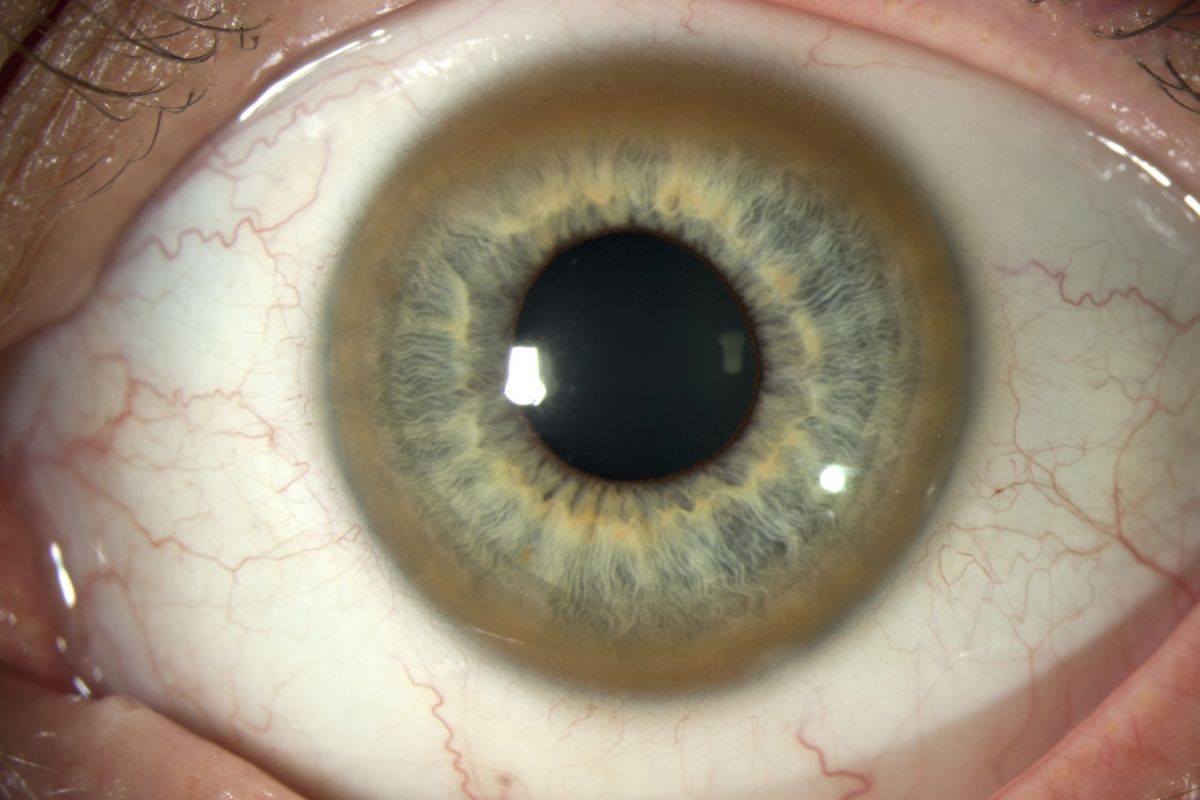
Answer: Kayser-Fleischer rings
Kayser-Fleischer ring is a hallmark of Wilson disease. The dense brown copper deposits encircle the iris. It requires slit-lamp examination. Though very highly suggestive of Wilson disease, Kayser-Fleischer rings are not specific for Wilson disease as they have been reported in cholestatic diseases, like primary biliary cirrhosis.
Clinical significance: Kayser-Fleischer rings gradually disappear with medical treatment for Wilson disease or if liver transplantation carried out. Their reappearance suggests either noncompliance or failed treatment.
Wednesday, September 2, 2015
Q: ICU resident had needle stick while performing a
procedure in an HIV positive patient. Resident decided not to take post-exposure
prophylaxis. What are her or his chances to contract
HIV?
Answer: The average risk of seroconversion after a needle stick injury is about 3 per 1000 with no prophylaxis. To be precise, it is between 0.23 to 0.36 percent.
References:
Tokars JI, Marcus R, Culver DH, et al. Surveillance of HIV infection and zidovudine use among health care workers after occupational exposure to HIV-infected blood. The CDC Cooperative Needlestick Surveillance Group. Ann Intern Med 1993; 118:913.
Baggaley RF, Boily MC, White RG,
Alary M. Risk of HIV-1 transmission for parenteral exposure and blood
transfusion: a systematic review and meta-analysis. AIDS 2006;
20:805.
Tuesday, September 1, 2015
Q: 52 year old female
from Cambodia, who just migrated to United States is admitted to ICU
with exacerbation of Asthma. It was noticed that patient's symptoms get worse,
every time she receives corticosteroids. Knowing her country of origin and above observation, which infectious disease should be considered? (choose
one)
A) Strogyloidiasis
B)
Malaria
C) Ebola
D) HIV
E) Yellow
Fever
Answer: A
Strongyloidiasis is common in many parts
of world where sanitation can be an issue. We choose Cambodia in above question
as disease is very prevalent in that area and could be a hint to answer. On interesting note, patients with
chronic Strongyloidiasis may also develop asthma that paradoxically may worsens
with corticosteroid use.
References:
Sen P, Gil C, Estrellas B, Middleton JR. Corticosteroid-induced asthma: a manifestation of limited hyperinfection syndrome due to Strongyloides stercoralis. South Med J 1995; 88:923.
Wehner JH, Kirsch CM, Kagawa FT, et al. The prevalence and response to therapy of Strongyloides stercoralis in patients with asthma from endemic areas. Chest 1994; 106:762.
Monday, August 31, 2015
Q: Which one of the following is the risk for Linezolid associated lactic acidosis?
A) Diabetes
B) Decrease GFR (golmerular filtration rate)
C) Previously documented bacteremia
D) Age
E) Duration of therapy
Answer: E
One recent study of 72 patients, published in International Journal of Infectious Disease showed that a longer duration of linezolid use, i.e more than 6 weeks use is one of the risk factors for metabolic acidosis. There was no statistically significant difference according to age, estimated glomerular filtration rate, or diabetes.
Reference:
Im JH, Baek JH, Kwon HY, Lee JS. - Incidence and risk factors of linezolid-induced lactic acidosis - J Infect Dis. 2015 Feb;31:47-52.
A) Diabetes
B) Decrease GFR (golmerular filtration rate)
C) Previously documented bacteremia
D) Age
E) Duration of therapy
Answer: E
One recent study of 72 patients, published in International Journal of Infectious Disease showed that a longer duration of linezolid use, i.e more than 6 weeks use is one of the risk factors for metabolic acidosis. There was no statistically significant difference according to age, estimated glomerular filtration rate, or diabetes.
Reference:
Im JH, Baek JH, Kwon HY, Lee JS. - Incidence and risk factors of linezolid-induced lactic acidosis - J Infect Dis. 2015 Feb;31:47-52.
Sunday, August 30, 2015
Q: Out of following, which one has shown to decrease vasospasm after sub-arachnoid hemorrhage SAH)?
A) Hydralazine
B) Beta blocker
C) Clonidine
D) Statin
E) Vitamin B6
Answer: D
Guidelines from the American Stroke Society recommends to administer statin therapy to patients after SAH to prevent vasospasm, after few trials showed that statin treatment is beneficial for preventing vasospasm and improving outcome after SAH. The mechanism is uncertain. Recommended dose is either pravastatin 40 mg daily or simvastatin 80 mg daily within 48 hours of diagnosis of aneurysmal SAH.
References:
1. Connolly ES Jr, Rabinstein AA, Carhuapoma JR, et al. Guidelines for the management of aneurysmal subarachnoid hemorrhage: a guideline for healthcare professionals from the American Heart Association/american Stroke Association. Stroke 2012; 43:1711.
2. McGirt MJ, Lynch JR, Parra A, et al. Simvastatin increases endothelial nitric oxide synthase and ameliorates cerebral vasospasm resulting from subarachnoid hemorrhage. Stroke 2002; 33:2950.
3. Lynch JR, Wang H, McGirt MJ, et al. Simvastatin reduces vasospasm after aneurysmal subarachnoid hemorrhage: results of a pilot randomized clinical trial. Stroke 2005; 36:2024.
4. Sillberg VA, Wells GA, Perry JJ. Do statins improve outcomes and reduce the incidence of vasospasm after aneurysmal subarachnoid hemorrhage: a meta-analysis. Stroke 2008; 39:2622.
5. Liu Z, Liu L, Zhang Z, et al. Cholesterol-reducing agents for aneurysmal subarachnoid haemorrhage. Cochrane Database Syst Rev 2013; 4:CD008184.
A) Hydralazine
B) Beta blocker
C) Clonidine
D) Statin
E) Vitamin B6
Answer: D
Guidelines from the American Stroke Society recommends to administer statin therapy to patients after SAH to prevent vasospasm, after few trials showed that statin treatment is beneficial for preventing vasospasm and improving outcome after SAH. The mechanism is uncertain. Recommended dose is either pravastatin 40 mg daily or simvastatin 80 mg daily within 48 hours of diagnosis of aneurysmal SAH.
References:
1. Connolly ES Jr, Rabinstein AA, Carhuapoma JR, et al. Guidelines for the management of aneurysmal subarachnoid hemorrhage: a guideline for healthcare professionals from the American Heart Association/american Stroke Association. Stroke 2012; 43:1711.
2. McGirt MJ, Lynch JR, Parra A, et al. Simvastatin increases endothelial nitric oxide synthase and ameliorates cerebral vasospasm resulting from subarachnoid hemorrhage. Stroke 2002; 33:2950.
3. Lynch JR, Wang H, McGirt MJ, et al. Simvastatin reduces vasospasm after aneurysmal subarachnoid hemorrhage: results of a pilot randomized clinical trial. Stroke 2005; 36:2024.
4. Sillberg VA, Wells GA, Perry JJ. Do statins improve outcomes and reduce the incidence of vasospasm after aneurysmal subarachnoid hemorrhage: a meta-analysis. Stroke 2008; 39:2622.
5. Liu Z, Liu L, Zhang Z, et al. Cholesterol-reducing agents for aneurysmal subarachnoid haemorrhage. Cochrane Database Syst Rev 2013; 4:CD008184.
Saturday, August 29, 2015
Q: What is the best prevention of avoiding limb ischemia in insertion of Intra-Aortic Balloon Pump (IABP)?
Answer: To avoid needle puncture which is too low.
If arterial needle puncture is too low in femoral area, probability is high of IABP insertion in one of the branches of femoral artery like superficial or profunda femoral artery. These branches are usually not large enough and may cause limb ischemia.
Answer: To avoid needle puncture which is too low.
If arterial needle puncture is too low in femoral area, probability is high of IABP insertion in one of the branches of femoral artery like superficial or profunda femoral artery. These branches are usually not large enough and may cause limb ischemia.
Friday, August 28, 2015
ON HEMODIALYSIS-INDUCED HYPOTENSION
One common misconception on hypotension during hemodialysis is naive thinking that induction of intravascular volume depletion by rapid ultrafiltration causes the problem. But in actuality it is not the only mechanism as patients can tolerate same rate of fluid removal with pure hemofiltration.
During conventional hemodialysis, the rapid diffusive removal of urea results in a reduction of the plasma osmolality. This creates two processes simultaneously. Firstly, water moves osmotically into the cells. Secondly, the rapid fall in plasma osmolality causes hemodynamic instability by interfering with sympathetic responsiveness to volume depletion.
During conventional hemodialysis, the rapid diffusive removal of urea results in a reduction of the plasma osmolality. This creates two processes simultaneously. Firstly, water moves osmotically into the cells. Secondly, the rapid fall in plasma osmolality causes hemodynamic instability by interfering with sympathetic responsiveness to volume depletion.
Reference:
Bergstrom J, Asaba H, Furst P, Oules R. Dialysis, ultrafiltration, and blood pressure. Proc Eur Dial Transplant Assoc 1976; 13:293.
Thursday, August 27, 2015
Post-intensive care syndrome (PICS)
Post-intensive care syndrome (PICS) is an extremely under recognised entity due to reasons as they usually happen outside of walls of ICU. It is defined as as new or worsening symptoms in three categories after a critical illness.
Prevention is the best treatment by sedation and neuro-muscular blockade (if use) holidays and most importantly by early physical mobilization in ICU.
Another associated entity is PICS-F (Post-intensive care syndrome -Family) in loved ones with sleep deprivation, depression, and PTSD. The best strategy to help out is the open and detailed communication.
References:
1. Needham DM, Davidson J, Cohen H, et al. Improving long-term outcomes after discharge from intensive care unit: report from a stakeholders' conference. Crit Care Med 2012; 40:502
2. Needham DM, Dinglas VD, Morris PE, et al. Physical and cognitive performance of patients with acute lung injury 1 year after initial trophic versus full enteral feeding. EDEN trial follow-up. Am J Respir Crit Care Med 2013; 188:567.
3.. Jackson JC, Pandharipande PP, Girard TD, et al. Depression, post-traumatic stress disorder, and functional disability in the BRAIN-ICU study: a longitudinal cohort study. Lancet Respir Med 2014; 5:369.
4. Hermans G, Van Mechelen H, Clerckx B, et al. Acute outcomes and 1-year mortality of intensive care unit-acquired weakness. A cohort study and propensity-matched analysis. Am J Respir Crit Care Med 2014; 190:410.
- cognitive, or/and
- psychiatric, or/and
- physical function
Prevention is the best treatment by sedation and neuro-muscular blockade (if use) holidays and most importantly by early physical mobilization in ICU.
Another associated entity is PICS-F (Post-intensive care syndrome -Family) in loved ones with sleep deprivation, depression, and PTSD. The best strategy to help out is the open and detailed communication.
1. Needham DM, Davidson J, Cohen H, et al. Improving long-term outcomes after discharge from intensive care unit: report from a stakeholders' conference. Crit Care Med 2012; 40:502
2. Needham DM, Dinglas VD, Morris PE, et al. Physical and cognitive performance of patients with acute lung injury 1 year after initial trophic versus full enteral feeding. EDEN trial follow-up. Am J Respir Crit Care Med 2013; 188:567.
3.. Jackson JC, Pandharipande PP, Girard TD, et al. Depression, post-traumatic stress disorder, and functional disability in the BRAIN-ICU study: a longitudinal cohort study. Lancet Respir Med 2014; 5:369.
4. Hermans G, Van Mechelen H, Clerckx B, et al. Acute outcomes and 1-year mortality of intensive care unit-acquired weakness. A cohort study and propensity-matched analysis. Am J Respir Crit Care Med 2014; 190:410.
Wednesday, August 26, 2015
Q: All of the following may decrease the rate of Ventilator Associated Pneumonia (VAP) except?
A) Oral hygiene via chlorhexidine mouthwash or gel
B) Head of bed elevation to reduce subglottic drainage
C) Maintaining an ETT airway cuff pressure to 10 to 20 cm H2O.
D) Minimizing transport out of the ICU
E) Application of 5 to 8 cm H2O of PEEP
Answer: C
All of the above have shown to decrease the rate of VAP, but cuff pressure of ETT should be maintained at 20 to 30 cm H2O.
In above question choice D is an interesting choice, but rationale behind relationship of VAP and Minimizing transport out of the ICU is the observational studies showing bedside resuscitation bags as a source of bacterial contamination.
References:
1. Kollef MH, Von Harz B, Prentice D, et al. Patient transport from intensive care increases the risk of developing ventilator-associated pneumonia. Chest 1997; 112:765.
2. Thompson AC, Wilder BJ, Powner DJ. Bedside resuscitation bags: a source of bacterial contamination. Infect Control 1985; 6:231.
3. Weber DJ, Wilson MB, Rutala WA, Thomann CA. Manual ventilation bags as a source for bacterial colonization of intubated patients. Am Rev Respir Dis 1990; 142:892.
A) Oral hygiene via chlorhexidine mouthwash or gel
B) Head of bed elevation to reduce subglottic drainage
C) Maintaining an ETT airway cuff pressure to 10 to 20 cm H2O.
D) Minimizing transport out of the ICU
E) Application of 5 to 8 cm H2O of PEEP
Answer: C
All of the above have shown to decrease the rate of VAP, but cuff pressure of ETT should be maintained at 20 to 30 cm H2O.
In above question choice D is an interesting choice, but rationale behind relationship of VAP and Minimizing transport out of the ICU is the observational studies showing bedside resuscitation bags as a source of bacterial contamination.
References:
1. Kollef MH, Von Harz B, Prentice D, et al. Patient transport from intensive care increases the risk of developing ventilator-associated pneumonia. Chest 1997; 112:765.
2. Thompson AC, Wilder BJ, Powner DJ. Bedside resuscitation bags: a source of bacterial contamination. Infect Control 1985; 6:231.
3. Weber DJ, Wilson MB, Rutala WA, Thomann CA. Manual ventilation bags as a source for bacterial colonization of intubated patients. Am Rev Respir Dis 1990; 142:892.
Tuesday, August 25, 2015
Q: 54 year old female is admitted to ICU with clonidine overdose. Patient appears very sedated. You are trying to avoid intubation. Which of the following drug may be use to reverse clonidine effect and may prevent intubation?
A) Flumazinil
B) Naloxone
C) Dexmedetomidine
D) Lopressor
E) Hemo-dialysis (HD)
Answer: B
Clonidine toxicity can be reversed with 1 to 2 mg x 1 dose of Naloxone, particularly in patients with CNS and respiratory depression. Interestingly, majority of patients who respond to naloxone do not require additional doses. If patient do not respond to x 1 attempt to Naloxone, further administration of Naloxone should be avoided and supportive care should be instituted till patient stabilized. And, if patient respond to Naloxone but symptoms recur later, intermittent doses can be used upto maximum of 10 mg. Continuous infusion should be preferably be avoided.
Flumazinil has no role in this situation
Dexmedetomidine and Lopressor may make symptoms worse, and
HD does not remove clonidine
1. Wiley JF 2nd, Wiley CC, Torrey SB, Henretig FM. Clonidine poisoning in young children. J Pediatr 1990; 116:654.
2. Spiller HA, Klein-Schwartz W, Colvin JM, et al. Toxic clonidine ingestion in children. J Pediatr 2005; 146:263.
A) Flumazinil
B) Naloxone
C) Dexmedetomidine
D) Lopressor
E) Hemo-dialysis (HD)
Answer: B
Clonidine toxicity can be reversed with 1 to 2 mg x 1 dose of Naloxone, particularly in patients with CNS and respiratory depression. Interestingly, majority of patients who respond to naloxone do not require additional doses. If patient do not respond to x 1 attempt to Naloxone, further administration of Naloxone should be avoided and supportive care should be instituted till patient stabilized. And, if patient respond to Naloxone but symptoms recur later, intermittent doses can be used upto maximum of 10 mg. Continuous infusion should be preferably be avoided.
Flumazinil has no role in this situation
Dexmedetomidine and Lopressor may make symptoms worse, and
HD does not remove clonidine
Reference:
1. Wiley JF 2nd, Wiley CC, Torrey SB, Henretig FM. Clonidine poisoning in young children. J Pediatr 1990; 116:654.
2. Spiller HA, Klein-Schwartz W, Colvin JM, et al. Toxic clonidine ingestion in children. J Pediatr 2005; 146:263.
Monday, August 24, 2015
Q: It is common for a patient to receive long term opiate infusion in ICU particularly while on ventilator. Abrupt discontinuation may lead to withdrawal symptoms. What various strategies may be used to prevent opiate withdrawal?
Answer; Patient who requires more than few days of opiate infusion may subject to withdrawal symptoms which may include agitation, lacrimation, diaphoresis, mydriasis, diarrhea, tremor, tachycardia, hypertension etc. Few strategies which may be used
References:
1. Honey BL, Benefield RJ, Miller JL, - Johnson PN. Alpha2-receptor agonists for treatment and prevention of iatrogenic opioid abstinence syndrome in critically ill patients. Ann Pharmacother 2009; 43:1506.
2. Al-Qadheeb NS, Roberts RJ, Griffin R, et al. Impact of enteral methadone on the ability to wean off continuously infused opioids in critically ill, mechanically ventilated adults: a case-control study. Ann Pharmacother 2012; 46:1160.
3. Maccioli GA. Dexmedetomidine to facilitate drug withdrawal. Anesthesiology 2003; 98:575.
Answer; Patient who requires more than few days of opiate infusion may subject to withdrawal symptoms which may include agitation, lacrimation, diaphoresis, mydriasis, diarrhea, tremor, tachycardia, hypertension etc. Few strategies which may be used
- Addition of clonidine
- Addition of dexmedetomidine
- conversion to oral opiates
- de-escalating the dose instead of abrupt withdrawal,
- Assurance
References:
1. Honey BL, Benefield RJ, Miller JL, - Johnson PN. Alpha2-receptor agonists for treatment and prevention of iatrogenic opioid abstinence syndrome in critically ill patients. Ann Pharmacother 2009; 43:1506.
2. Al-Qadheeb NS, Roberts RJ, Griffin R, et al. Impact of enteral methadone on the ability to wean off continuously infused opioids in critically ill, mechanically ventilated adults: a case-control study. Ann Pharmacother 2012; 46:1160.
3. Maccioli GA. Dexmedetomidine to facilitate drug withdrawal. Anesthesiology 2003; 98:575.
Sunday, August 23, 2015
Q: What is the 'rule of thumb' for titrating the neuro-muscular blockade (NMB) infusion in ICU?
Answer: The depth of neuromuscular blockade should be monitored by peripheral nerve stimulation (PNS), popularly know as 'Train of Four' (TOF). In first 24 hours, it should be assessed every 2 hours and once goal of '2/4 TOF' is achieved, frequency can be decreased to q12 hours.
As a 'rule of thumb' dose should be reduced approximately 10 percent if TOF is 0/4 or 1/4 - or increased by by 10 percent if TOF level is 3/4 or 4/4.
Alike concept of 'sedation holiday' daily discontinuation of NMB should be performed to assess clinical progress and decrease complications, particularly critical illness myopathy.
Reference:
Murray MJ, Cowen J, DeBlock H, et al. Clinical practice guidelines for sustained neuromuscular blockade in the adult critically ill patient. Crit Care Med 2002; 30:142.
Answer: The depth of neuromuscular blockade should be monitored by peripheral nerve stimulation (PNS), popularly know as 'Train of Four' (TOF). In first 24 hours, it should be assessed every 2 hours and once goal of '2/4 TOF' is achieved, frequency can be decreased to q12 hours.
As a 'rule of thumb' dose should be reduced approximately 10 percent if TOF is 0/4 or 1/4 - or increased by by 10 percent if TOF level is 3/4 or 4/4.
Alike concept of 'sedation holiday' daily discontinuation of NMB should be performed to assess clinical progress and decrease complications, particularly critical illness myopathy.
Reference:
Murray MJ, Cowen J, DeBlock H, et al. Clinical practice guidelines for sustained neuromuscular blockade in the adult critically ill patient. Crit Care Med 2002; 30:142.
Saturday, August 22, 2015
Q: Which of the following Neuro-muscular blockade should be avoided in cocaine overdose?
A) cisatracurium
B) succinylcholine
C) vecuronium
D) pancuronium
E) atracurium
Answer: B
Succinylcholine can prolong the effects of cocaine and is usually advised not be used in Rapid sequence intubation, if required. Rocuronium is preferred. It is not a absolute but a relative contraindication.
A) cisatracurium
B) succinylcholine
C) vecuronium
D) pancuronium
E) atracurium
Answer: B
Succinylcholine can prolong the effects of cocaine and is usually advised not be used in Rapid sequence intubation, if required. Rocuronium is preferred. It is not a absolute but a relative contraindication.
Friday, August 21, 2015
HAS-BLED score
Q: What is HAS-BLED score?
Answer: The HAS-BLED score was developed as a practical risk score to estimate the 1-year risk for major bleeding in patients on anticoagulation (mostly coumadin) with atrial fibrillation. Risk progressively goes up as score goes up like score of 2 has risk of 4.1% in one validation study and 1.88 bleeds per 100 patient-years in another validation study. Likewise, score of 4 has risk of 8.9% in one validation study and 8.70 bleeds per 100 patient-years in another validation study.

Answer: The HAS-BLED score was developed as a practical risk score to estimate the 1-year risk for major bleeding in patients on anticoagulation (mostly coumadin) with atrial fibrillation. Risk progressively goes up as score goes up like score of 2 has risk of 4.1% in one validation study and 1.88 bleeds per 100 patient-years in another validation study. Likewise, score of 4 has risk of 8.9% in one validation study and 8.70 bleeds per 100 patient-years in another validation study.

Thursday, August 20, 2015
Oral lidocaine for intractable hiccups
Interesting report
BACKGROUND: Persistent and intractable hiccups are a rather rare, but distressing gastrointestinal symptom found in palliative care patients. Although several recommendations for treatment are given, hiccups often persist.
CASE REPORTS: We describe a new pharmacological approach for successfully treating hiccups in four cancer patients. In the first patient, chronic and intractable hiccups lasted for more than 18 months, but disappeared immediately after swallowing a viscous 2 % lidocaine solution for treatment of mucositis. Based on this experience, we successfully treated three further patients suffering from singultus using a lidocaine-containing gel. To our knowledge, this is the first report about managing hiccups by oral application of a lidocaine solution.
Reference:
Neuhaus T1, Ko YD, Stier S. - Successful treatment of intractable hiccups by oral application of lidocaine - Support Care Cancer. 2012 Nov;20(11):3009-11. Epub 2012 Jul 22.
BACKGROUND: Persistent and intractable hiccups are a rather rare, but distressing gastrointestinal symptom found in palliative care patients. Although several recommendations for treatment are given, hiccups often persist.
CASE REPORTS: We describe a new pharmacological approach for successfully treating hiccups in four cancer patients. In the first patient, chronic and intractable hiccups lasted for more than 18 months, but disappeared immediately after swallowing a viscous 2 % lidocaine solution for treatment of mucositis. Based on this experience, we successfully treated three further patients suffering from singultus using a lidocaine-containing gel. To our knowledge, this is the first report about managing hiccups by oral application of a lidocaine solution.
Reference:
Neuhaus T1, Ko YD, Stier S. - Successful treatment of intractable hiccups by oral application of lidocaine - Support Care Cancer. 2012 Nov;20(11):3009-11. Epub 2012 Jul 22.
Wednesday, August 19, 2015
Q: In hemolytic Anemia? (Choose one)
A) LDH goes up, Reticulocyte count goes up, Indirect bilirubin goes up
B) LDH goes up, Reticulocyte count goes up, Direct bilirubin goes up
C) LDH goes up, Reticulocyte count goes up, Serum haptoglobin goes up
D) LDH goes down, Reticulocyte count goes up, Serum haptoglobin goes down
E) LDH goes down, Reticulocyte count goes down, Serum haptoglobin goes up
Answer: A
Hemolytic Anemia is a common entity in ICU particularly if any device is cannulated to patient. Few simple tips to diagnose hemolytic anemia is
A) LDH goes up, Reticulocyte count goes up, Indirect bilirubin goes up
B) LDH goes up, Reticulocyte count goes up, Direct bilirubin goes up
C) LDH goes up, Reticulocyte count goes up, Serum haptoglobin goes up
D) LDH goes down, Reticulocyte count goes up, Serum haptoglobin goes down
E) LDH goes down, Reticulocyte count goes down, Serum haptoglobin goes up
Answer: A
Hemolytic Anemia is a common entity in ICU particularly if any device is cannulated to patient. Few simple tips to diagnose hemolytic anemia is
- Increased indirect bilirubin concentration
- Splenomegaly
- Increased serum lactate dehydrogenase (LDH) concentration
- Reduced or absent level of serum haptoglobin
- Increased reticulocyte percentage or absolute reticulocyte number
Tuesday, August 18, 2015
Q: 32 year old female
admitted to ICU with seizure, preceded by severe headache. There is a strong
suspicion of subarachnoid hemorrhage (SAH). Noncontrast CT of head is reported
negative. Neurosurgeon requests you to perform lumbar puncture (LP) to confirm
SAH. As you collect all four test tubes of CSF, you suspect some 'pinkish' tinge
in fluid. What is your suspicion?
Answer: Xanthochromia
Xanthochromia which is actually
a pinkish or a yellowish tint signifies, hemoglobin degradation products in CSF,
and is highly suggestive of SAH. The best way to confirm xanthochromia is
by comparing a vial of CSF with a vial of plain water held side by side
against a white background in bright light. It is important to perform this
visual inspection quickly after LP to distinguish it from traumatic LP. The
presence of xanthochromia in just performed LP indicates that blood has been in
the CSF for at least two hours.
Reference:
Wijdicks EF, Kallmes DF, Manno EM, et al. Subarachnoid hemorrhage: neurointensive care and aneurysm repair. Mayo Clin Proc 2005; 80:550.
Monday, August 17, 2015
Q: 21 year old male presented to ER with palpitations, sweating and headache. He was found to be hypertensive in ER. Urine tox screen was negative. Patient BP was unresponsive to Cardene drip and is admitted to ICU. On history taking, patient informed you that his symptoms started while night out with friends, drinking lot of wine, imported beer and eating huge amount of smoked meat. Patient is taking anti-depressant at home. You suspect pheochromocytoma but patient informed you that he has been worked up in past and is ruled out for pheochromocytoma?
Answer:
Combination of a monoamine oxidase (MAO) inhibitor drugs and the ingestion of tyramine-containing foods may produce symptoms similar to pheochromocytoma.
Major MAO inhibitors include antidepressant drugs tranylcypromine, phenelzine, and isocarboxazid. Foods contain relatively high concentrations of tyramine fermented cheeses, imported beer, Chianti, champagne, some wines, soy sauce, avocados, bananas, and any fermented, smoked, or aged fish or meat. These food should be avoided by patients on these antidepressants. Tyramine, which is produced from the bacterial breakdown of tyrosine, is normally inactivated by MAO in the intestinal tract. This inactivation does not occur in the presence of an MAO inhibitor, leading to the absorption of tyramine, which increases the release of norepinephrine from nerve endings and epinephrine from the adrenal gland.
Answer:
Combination of a monoamine oxidase (MAO) inhibitor drugs and the ingestion of tyramine-containing foods may produce symptoms similar to pheochromocytoma.
Major MAO inhibitors include antidepressant drugs tranylcypromine, phenelzine, and isocarboxazid. Foods contain relatively high concentrations of tyramine fermented cheeses, imported beer, Chianti, champagne, some wines, soy sauce, avocados, bananas, and any fermented, smoked, or aged fish or meat. These food should be avoided by patients on these antidepressants. Tyramine, which is produced from the bacterial breakdown of tyrosine, is normally inactivated by MAO in the intestinal tract. This inactivation does not occur in the presence of an MAO inhibitor, leading to the absorption of tyramine, which increases the release of norepinephrine from nerve endings and epinephrine from the adrenal gland.
Sunday, August 16, 2015
A note on Fospropofol
Fospropofol is a water-soluble propofol prodrug. It has various advantage due to its water solubility like less pain at the site of IV infusion, so can be given via peripheral IV with more comfort. It carries less chance for hyperlipidemia, and subsequently less chance for bacteremia. Because of said advantage, it is a good choice for use in short-term sedation for patients undergoing procedures such as endoscopy. Fospropofol is metabolized by alkaline phosphatases to propofol, formaldehyde, and phosphate.
Saturday, August 15, 2015
Q: 42 year old male in ICU went into grand mal seizure. 2 mg of IV lorazepam is administrated but did not bring any relief. Another dose of 2 mg of lorazepam is ordered and simultaneously phenytoin is ordered. Which one caution should be exercise very closely while treating this patient?
Answer: Phenytoin is incompatible with almost any of the benzodiazepines, and should not be administrated with same IV line, otherwise will precipitate. Another IV line should be established ASAP. Similarly is true for phenytoin and any fluid with glucose/dextrose. This does not apply to fosphenytoin infusion.
Answer: Phenytoin is incompatible with almost any of the benzodiazepines, and should not be administrated with same IV line, otherwise will precipitate. Another IV line should be established ASAP. Similarly is true for phenytoin and any fluid with glucose/dextrose. This does not apply to fosphenytoin infusion.
Friday, August 14, 2015
Q: Which of the following drug overdose may presents as non-cardiogenic pulmonary edema?
A) Phenytoin
B) Furosemide
C) Salicylate
D) Propofol
E) Lorazepam
Answer: C
Salicylate-induced noncardiogenic pulmonary edema is usually seen as an acute on chronic salicylate poisoning. Elderly people are more prone to it. Salicylate-induced pulmonary edema is considered as an absolute indication for hemodialysis.
Phenytoin toxicity does not produce pulmonary edema. Furosemide is usually the treatment of cardiogenic pulmonary edema. It should be use with caution in non-cardiogenic pulmonary edema. Propofol infusion syndrome may cause acute MI and subsequently cardiogenic pulmonary edema. Heroin and Methadone are known to produce non-cardiogenic pulmonary edema but Lorazepam is not.
A) Phenytoin
B) Furosemide
C) Salicylate
D) Propofol
E) Lorazepam
Answer: C
Salicylate-induced noncardiogenic pulmonary edema is usually seen as an acute on chronic salicylate poisoning. Elderly people are more prone to it. Salicylate-induced pulmonary edema is considered as an absolute indication for hemodialysis.
Phenytoin toxicity does not produce pulmonary edema. Furosemide is usually the treatment of cardiogenic pulmonary edema. It should be use with caution in non-cardiogenic pulmonary edema. Propofol infusion syndrome may cause acute MI and subsequently cardiogenic pulmonary edema. Heroin and Methadone are known to produce non-cardiogenic pulmonary edema but Lorazepam is not.
Thursday, August 13, 2015
Q: Is it necessary to document fat globules in blood drawn from a wedged PA catheter to confirm diagnosis of Fat Embolism Syndrome? (Yes or No)?
Answer: NO
It is not necessary to document fat globules in sputum, urine, or blood drawn from a wedged PA catheter to confirm the diagnosis of Fat Embolism Syndrome. 50 percent of patients with fracture may have fat globules in serum without any sign, symptom or diagnosis of Fat Embolism Syndrome. This misconception probably arises from the notion that debris need to be documented in amniotic fluid embolism in blood drawn from a wedged PA catheter, which in contrast is not necessary in fat embolism syndrome.
Answer: NO
It is not necessary to document fat globules in sputum, urine, or blood drawn from a wedged PA catheter to confirm the diagnosis of Fat Embolism Syndrome. 50 percent of patients with fracture may have fat globules in serum without any sign, symptom or diagnosis of Fat Embolism Syndrome. This misconception probably arises from the notion that debris need to be documented in amniotic fluid embolism in blood drawn from a wedged PA catheter, which in contrast is not necessary in fat embolism syndrome.
Wednesday, August 12, 2015
Q: In OR "Cell Saver" technique (intraoperative autologous transfusion or intraoperative autotransfusion) is frequently used. Why it is important to wash the blood before infusion back into patient?
Answer: Blood from patient needs to be
Salvaged blood should be washed. Unwashed salvaged blood has residual anticoagulant, dysfunctional platelets, thrombogenic substances, free hemoglobin levels, and fat emboli.
Answer: Blood from patient needs to be
- processed/collected in a sterile, filtered reservoir,
- centrifuged, which separates and concentrates higher density RBCs
- washed – with an isotonic solution, and
- reinfused
Salvaged blood should be washed. Unwashed salvaged blood has residual anticoagulant, dysfunctional platelets, thrombogenic substances, free hemoglobin levels, and fat emboli.
Monday, August 10, 2015
The FOUR Score
Q: What advantage The FOUR score has over Glascow Coma Scale (GCS)?
Answer: Glascow Coma Scale (GCS) cannot be administered to patients with an endotracheal tube. The FOUR Score is to created as a clinical grading scale for the assessment of patients with impaired level of consciousness that can be used in patients with or without endotracheal intubation.
The "FOUR" is an acronym for "Full Outline of UnResponsiveness", and the FOUR Score assesses four domains of neurological function:
Answer: Glascow Coma Scale (GCS) cannot be administered to patients with an endotracheal tube. The FOUR Score is to created as a clinical grading scale for the assessment of patients with impaired level of consciousness that can be used in patients with or without endotracheal intubation.
The "FOUR" is an acronym for "Full Outline of UnResponsiveness", and the FOUR Score assesses four domains of neurological function:
- eye responses,
- motor responses,
- brainstem reflexes, and
- breathing pattern.

Subscribe to:
Posts (Atom)